
A Q&A with Caheri Gutierrez and Demetria Huntsman
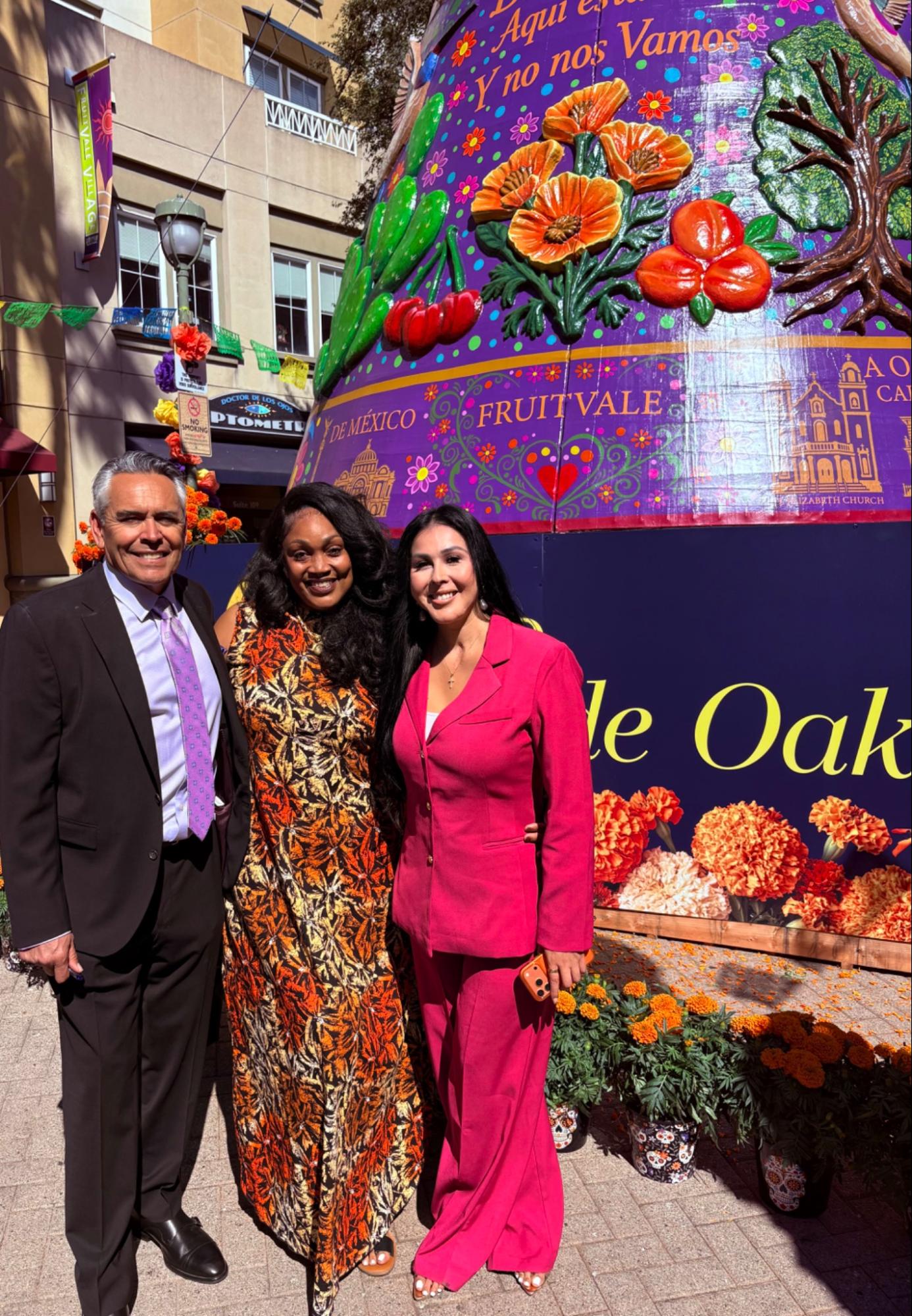
Earlier this month, hundreds of Oaklanders gathered at Fruitvale Plaza to properly welcome La Catrina. The unveiling celebration was truly Town Bizness, complete with baile folklórico from Oakland’s Fremont High School, Turf Inc. dancers, and a mariachi performance.
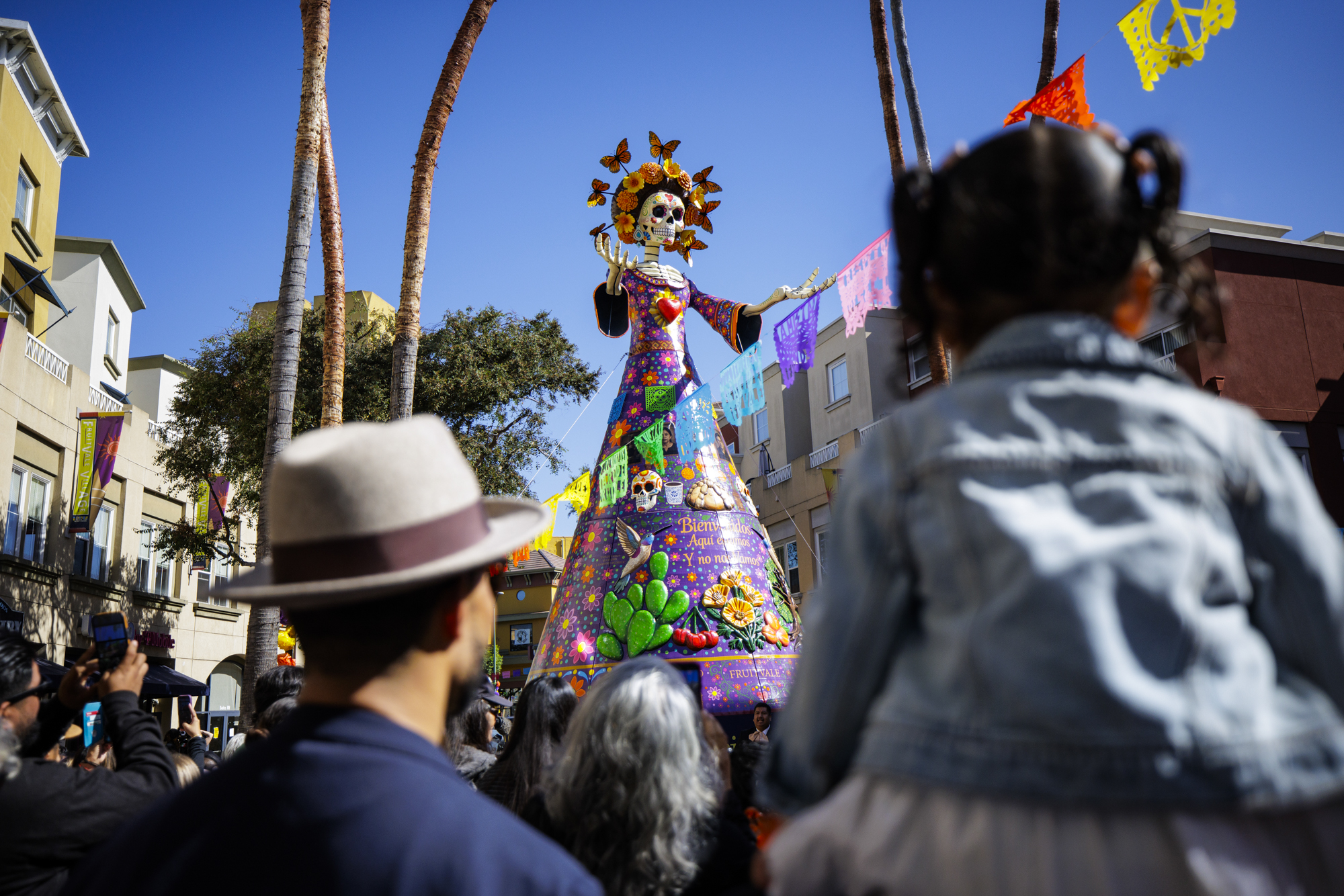
La Catrina is one of the most recognized symbols of Día de los Muertos, standing for remembrance, the celebration of life, and the enduring connection between generations. At a towering 34 feet, Oakland’s Catrina, is true to tradition and also completely in a class of her own, with dangling earrings, California motifs adorning her dress, and outstretched arms ready to welcome and embrace.
Commissioned and shepherded by our partners at The Unity Council, La Catrina is a testament to Oakland’s Latino community. Her journey from Mexico City to Oakland mirrors the journey so many of our neighbors have made, carrying memories, lineages, and culture across borders to be met with open arms in our beloved Town.
At Akonadi, our arts and culture work supports efforts that bring people together in real life, hold legacy and memory, and help our communities imagine and build a more racially just Oakland. We were proud to support The Unity Council’s community programming to celebrate La Catrina’s arrival.
We sat down with The Unity Council’s Director of Fund Development and Communications, Caheri Gutierrez, and Akonadi’s Senior Program Officer, Demetria Huntsman, to talk about what La Catrina means to Oakland, why investing in culture matters right now, and how you can experience her this Día de Los Muertos.
We’re so proud that Oakland’s Catrina is the tallest in the entire United States, and that she lives in the heart of the Town, the Fruitvale District. The reason The Unity Council brought her is that she represents a statement of defiance for our community during this political time.
What is the significance of La Catrina and why did The Unity Council want to bring one to Oakland, and specifically to the Fruitvale district?
Caheri Gutierrez: La Catrina is a traditional staple in Mexican culture, specifically around Día de los Muertos. She represents remembrance, history, ancestry, and culture. She’s a very special figure who embodies love for our families and for the loved ones who have passed on, a way to honor their lives and always remember them. She’s a very important symbol, not just in Mexican culture, but in humanity.
We’re so proud that Oakland’s Catrina is the tallest in the entire United States, and that she lives in the heart of the Town, the Fruitvale District. The reason The Unity Council brought her is that she represents a statement of defiance for our community during this political time.
Last year, we started to hear about potential mass ICE raids in the Bay Area. We knew they were happening across California, and Oakland has a 31% Latino population and is only growing. Community members were reaching out to The Unity Council, an anchor institution that’s been in the Fruitvale for over six decades, with a lot of concern and fear. Every November, we put on our Día de los Muertos festival, and it’s such a beautiful moment to celebrate our culture. But with news of possible ICE raids, people were rightfully afraid. They told us, “We’re terrorized. We don’t know if it’s a good idea for community members to come together in this space.”
We had a very comprehensive conversation with city officials, developed a safety plan, and ultimately felt confident that the best decision was to move forward with the festival and not let fear terrorize our communities, but instead to rejoice in the culture, resilience, and defiance that Oakland is known for. So we went ahead, and no ICE showed up. Everybody was protected, with ICE watchers throughout the festival holding our community down. It was one of the most successful festivals in The Unity Council’s history. To build on that momentum, we said we needed to bring something huge and monumental to keep instilling that pride and resilience in our community. What’s better than La Catrina?
La Catrina mirrors the journey of generations of Mexicans, and generations of Latin Americans that have also taken that route from the south all the way to the north, to arrive in Oakland with open arms. Her dress literally says Bienvenidos, and her arms are extended in a welcoming embrace, letting people know that you’re home, you belong here, and you can thrive here.
Can you share more about the connections between Mexico and Oakland?
Caheri: Oakland has historically been home to diverse Latino communities. In the early years, many Mexicans came to Oakland, and many of them settled in the Fruitvale. As demographics have changed, there are also large Central American communities in the Fruitvale now, and we love that, because it represents Latin America as a whole.
Mexico and Oakland also have a long-standing relationship in terms of the migration route. A lot of folks from Mexico and Latin America make the journey up north to Oakland because they’ve always known that Oakland is a sanctuary, that they are welcomed in Oakland and in the Fruitvale. La Catrina mirrors the journey of generations of Mexicans, and generations of Latin Americans that have also taken that route from the south all the way to the north, to arrive in Oakland with open arms. Her dress literally says Bienvenidos, and her arms are extended in a welcoming embrace, letting people know that you’re home, you belong here, and you can thrive here.
What were some of your favorite moments from the unveiling of La Catrina with the community?
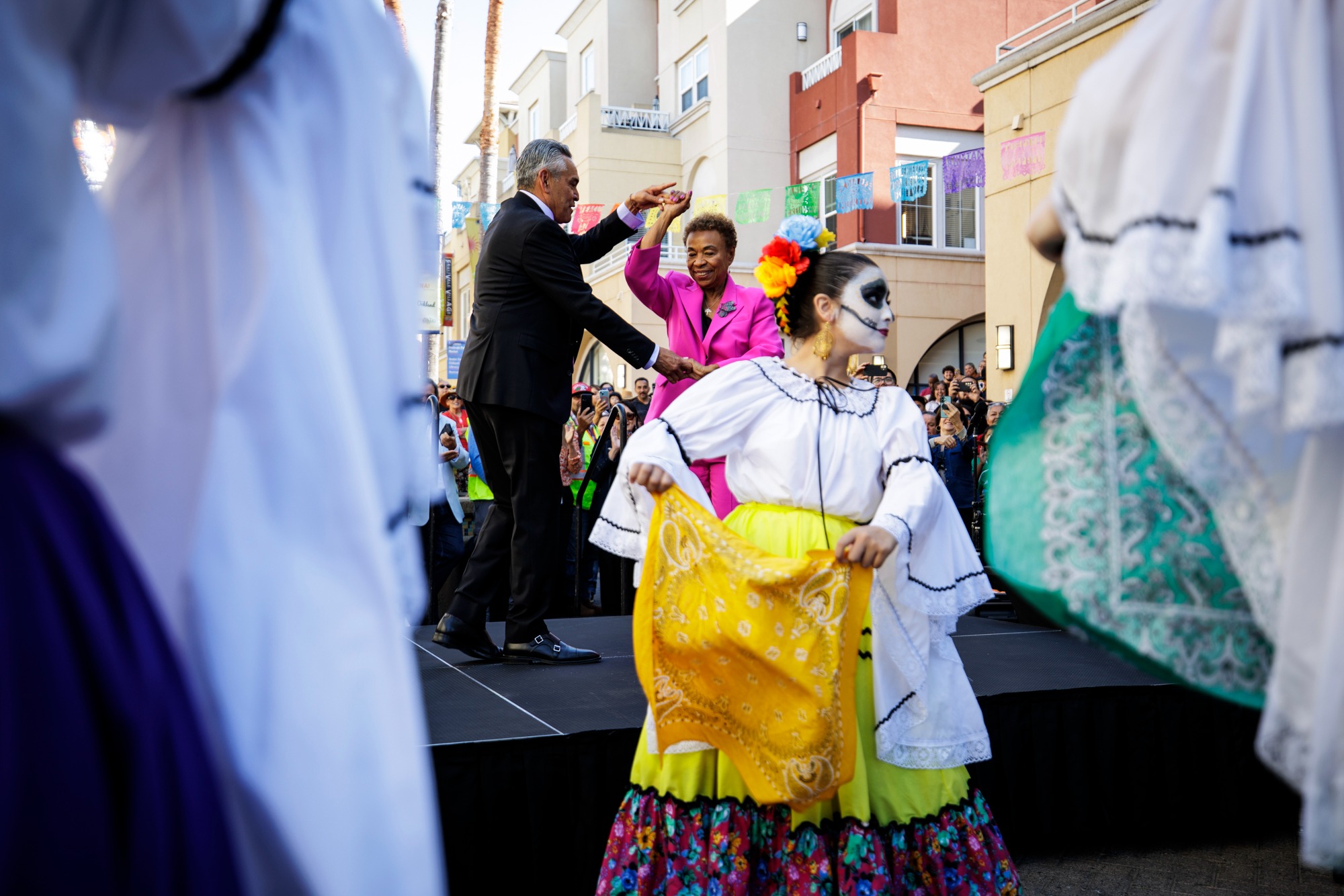
Caheri: The unveiling ceremony was, man, better than we could have ever expected. The program was perfect and beautiful, and it really represented Oakland. Mayor Lee and the Mexican Consul joined us to share remarks. There was a beautiful balance of our culture with baile folklórico from Fremont High, and then Turf Inc. representing the realness, the urbanness, the Town Bizness that Oakland is. That was the best way we could represent Oakland – we’re traditional, we’re about community, we celebrate our culture. And we’re also hyphy and real.
Demetria Huntsman: The unveiling was just so transformational. Those are the moments we want to see, when all of these different elements of Oakland culture come together. When the mariachi came out to perform, and Mayor Lee jumped up and started dancing with the CEO of the Unity Council, in that moment, it felt like we were all untouchable.
I thought, this is Oakland. This is it. This is who I am. This is what raised me. It exists, and I want to fight for it. I felt so much more deeply committed to my community. What a magical thing to experience.
She is that girl. Everybody is talking about her on a local level, on a regional level, and at a federal level, as well as internationally. The expressions on people’s faces when they see her are priceless. Folks get a moment to raise their heads high, see their culture and Oakland reflected, and carry a symbol of pride and resilience with them despite what’s happening right now.
How has the community received La Catrina?
Caheri: She’s been so well received. Folks really saw themselves and saw Oakland represented in the best way. Close to a thousand people showed up for the unveiling: children, grandparents, community members, elected officials, everyone. And that’s the impact of this Catrina. She is not a self-serving monument. She has brought so many people to the Fruitvale Transit Village, where a lot of small businesses operate, and so many owners have thanked us because they haven’t seen this many people there since the pandemic. It’s creating an economic boom and boosting our local economy. People are coming into the shops and buying café and churros on their way to and from the Catrina.
She is that girl. Everybody is talking about her on a local level, on a regional level, and at a federal level, as well as internationally. The expressions on people’s faces when they see her are priceless. Folks get a moment to raise their heads high, see their culture and Oakland reflected, and carry a symbol of pride and resilience with them despite what’s happening right now.
What do you hope people take away from viewing and learning about the piece?
Demetria: I hope people take away that Oakland has always been culturally rich, and that so much of our richness is tied to our resilience. As many places, Oakland has faced incredible adversity: the crack epidemic, gentrification, the pandemic, and currently, the attacks of the federal government and the tech oligarchs, but we are still here and still strong!
I’ve gone to Mexico City during the Day of the Dead and seen incredible installations. We can experience the world in so many ways, as we should, and we also have our whole world right here. I can’t imagine what it was like for Chris [CEO of the Unity Council] to say, “We need a La Catrina in the Fruitvale. Find an artist and let’s get it popping.“ Talk about radical imagination. I’m amazed that somebody can look at a blank canvas and land on an incredible masterpiece, and I think it speaks to Oakland’s reverence for diverse cultures that we do things like this.
Oakland really is a magical place, and I am so thankful that it is a part of me.
Our movements and organizing are inherently relational. It is how we connect, how we find our shared values, and how we understand what’s affecting our communities and what we can do to change it. We cannot allow our humanity to be replaced, and arts and culture bring us back to our humanity. They give us every opportunity to radically imagine the world that we want to live in, and not just consume what is being given to us.
How does La Catrina connect to Akonadi’s strategy for investing in arts and culture over the next few years?
Demetria: In this next chapter of our arts and culture strategy, we want to advance narratives that let us co-create meaning with the community and with the people participating in art and culture, in a way that aligns with Akonadi’s vision for building a racially just Oakland. It’s about holding legacy and memory, and doing that meaning-making together. It also means making sure there’s a scale, a strategy, and an audience that culture is being deployed to connect with. And we want to fund work that intentionally brings people together for deeper connection.
We went through the pandemic, and people really became very isolated. The practices we adopted then created a cultural shift that still shapes how we interact with each other today. Technology is changing the way we interact as humans. I’m seasoned enough to remember when the internet and virtual spaces only enhanced our real life connections. Now we live in that virtual world, and it doesn’t enhance humanity. It’s really started to replace our humanity.
Our movements and organizing are inherently relational. It is how we connect, how we find our shared values, and how we understand what’s affecting our communities and what we can do to change it. We cannot allow our humanity to be replaced, and arts and culture bring us back to our humanity. They give us every opportunity to radically imagine the world that we want to live in, and not just consume what is being given to us.
What can Oaklanders look forward to, leading up to Dia de Los Muertos?
Caheri: The welcome ceremony was fabulous, and it kicked off the celebration. Every Saturday throughout October, we’ve been holding free family activations in the Fruitvale, 100% thanks to Akonadi. They wanted to support the community engagement piece of this, and their grant made it possible for hundreds and hundreds of families to gather in the Fruitvale at no cost.
These are families who fear their federal support will be cut, and who fear going to work and missing a paycheck because of the rhetoric that’s happening. They’re gathering safely and joyfully to enjoy time with their children and families. When you talk about social justice and community, that is how Akonadi shows up in partnership with community-based organizations. I want to shout out Akonadi for creating that moment for us.
Then, on Día de los Muertos, November 1st, La Catrina is going to be the centerpiece of our festival. We’ll have over 280 vendors, altar exhibitions that keep the traditional aspects of the holiday, and three stages of entertainment. It’s free for everyone to attend, and we’re expecting well over 100,000 attendees.
I think La Catrina has added to the excitement, and it’s not just Bay Area people coming. When I’ve sat and had lunch near her and chatted with visitors, they’ve told me about they’re coming from Lake Shasta, Fresno, the Central Valley. People are showing up for this, and it’s going to be huge and monumental. It will without a doubt be one of California’s, if not the United States’, most historic Día de Los Muertos festivals.
