
By Pastor Todd Benson, Executive Director, Faith in Action East Bay
At Akonadi Foundation, we believe that deep, sustained grassroots organizing is essential to building community power and creating lasting change in Oakland. As part of our ongoing series spotlighting our grantee partners, we invited Pastor Todd Benson, Executive Director of Faith in Action East Bay, to reflect on how faith, hope and community organizing can help people recognize their collective power, shape the decisions that affect their lives and build a more just future. Hear more from him below.
There are real reasons people feel cynical and exhausted right now. There are so many forces telling us that we don’t have power, that our voices don’t matter or that nothing will change. But I have also seen what happens when people who thought they had no power begin to recognize the power they have together.
Hope Is a Discipline
When I think about what gives me hope, one of the things I often say is that hope is a discipline. It’s not an emotion. Hope is doing the work.
There are real reasons people feel cynical and exhausted right now. There are so many forces telling us that we don’t have power, that our voices don’t matter or that nothing will change. But I have also seen what happens when people who thought they had no power begin to recognize the power they have together.
At Faith in Action East Bay, we organize in congregations and schools around Alameda and Contra Costa County where people already have a sense of community. For congregations in particular, these are places where people feel comfortable and bring in important parts of themselves and their lives. That matters because organizing is about meeting people where they are and building relationships.
We talk in organizing about self-interest, but not in a narrow, “I want to be a millionaire” kind of way. We mean what is really important to us in our lives. If you are a parent, making sure your child gets a good education is going to be important to you. If you are an immigrant, the safety of your family may be what keeps you up at night.
Building Power in Our Communities
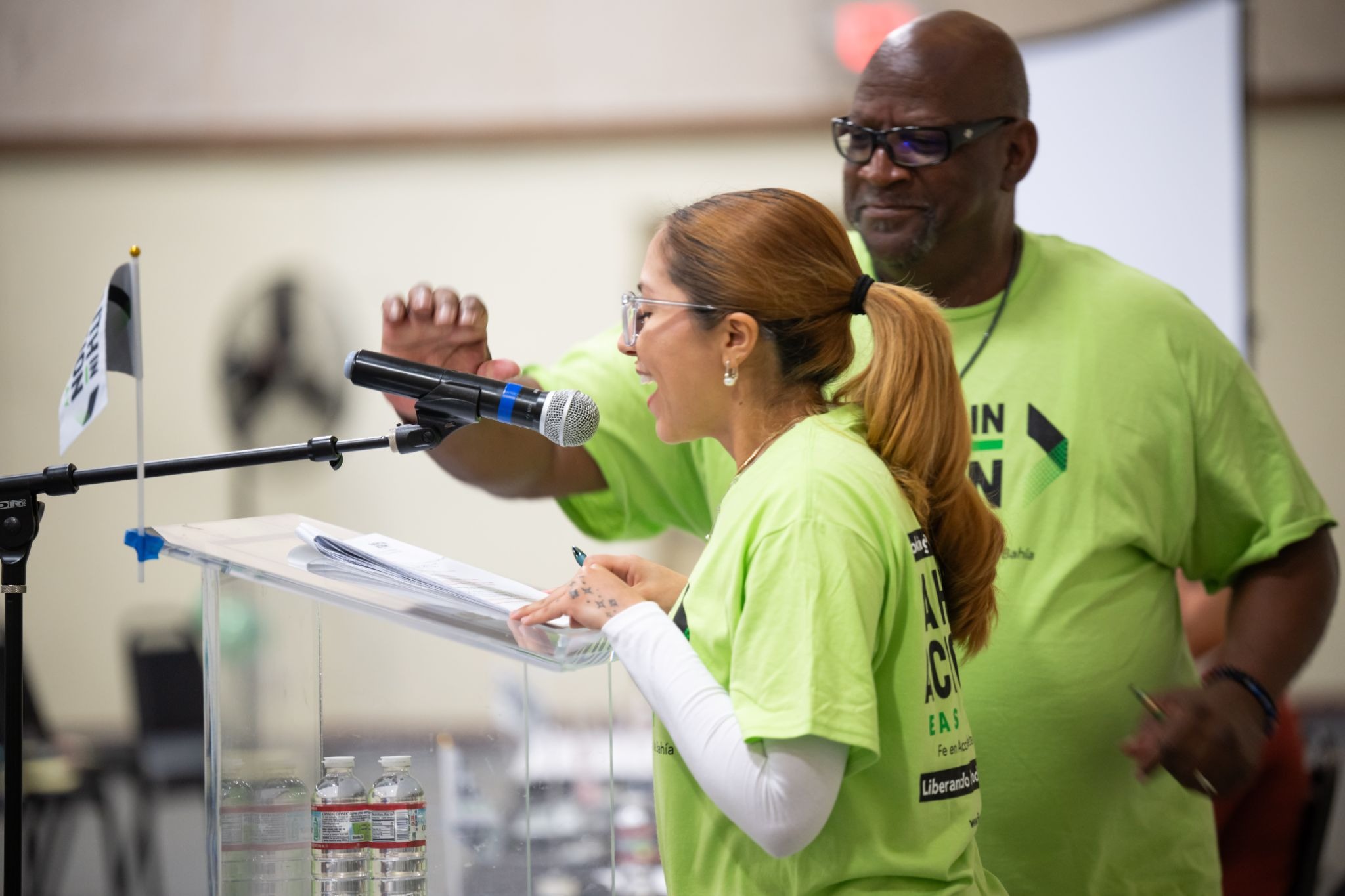
That means our organizing changes as the needs of our communities change. Over the years, we have worked extensively around gun violence, including organizing to secure funding for the Oakland Ceasefire Strategy, an approach that connects directly with people who are most at risk of being involved in or victimized by violence and connects them with services and alternatives, and continuing to participate in peace walks and violence prevention efforts. We have organized around illegal dumping, particularly in Black and brown communities. And right now, immigrant protection has become an increasingly important part of our work.
Since January 2025, immigrant families have been living with tremendous fear. Our immigrant leaders helped lead a successful effort to strengthen Oakland’s City of Refuge ordinance, expanding protections across city departments and limiting the ways the city can cooperate or share information with ICE.
There are so many factors in our culture that tell us we don’t have power. There is actually a concept called surplus powerlessness, an idea from Rabbi Michael Lerner that I first learned about in seminary. It is the self-imposed or psychological powerlessness that people adopt when their own emotional, intellectual, or spiritual makeup stops them from changing things they actually have the power to change.
We also asked a group of mostly undocumented people we organized with what they needed most right now. They told us that when someone is detained or deported and that person is the breadwinner, their family suddenly loses its source of income. They said we needed to raise money to support those families, and we listened. Through a GoFundMe and additional foundation support, we have helped raise around $72,000 for roughly 80 to 85 families.
Helping People Realize Their Own Power
The way I see it, organizing has two arms. One arm is the issue we are working on — stopping gun violence, ending illegal dumping in mostly Black and brown communities, protecting immigrants. The other arm is helping people realize their own power.
There are so many factors in our culture that tell us we don’t have power. There is actually a concept called surplus powerlessness, an idea from Rabbi Michael Lerner that I first learned about in seminary. It is the self-imposed or psychological powerlessness that people adopt when their own emotional, intellectual, or spiritual makeup stops them from changing things they actually have the power to change.
It is easy to become cynical, especially when you have watched things fail to change over and over again. People think, Nothing is going to change. We can’t make a difference. Only wealthy people have access to politicians. I would never meet with a city council member or a county supervisor.
Sometimes keeping our hopes low becomes almost a defense mechanism. We have been disappointed so many times that we don’t want to be disappointed again. If we convince ourselves nothing can be done, we don’t have to risk getting our hopes up. But organizing gives people the opportunity to experience something different.
During our campaign to strengthen Oakland’s City of Refuge ordinance, a number of our leaders spoke during public comment at City Hall. A couple of days later, I was leaving an event when a woman who I had never met before, who knew I was the executive director for Faith In Action, told me, “I spoke at City Hall last night.”
She was so proud. I later learned that English was not her first language and she had spoken through a translator. She had done something I don’t think she ever imagined herself doing.
Those moments are just as important to me as the policy victories because that is the second arm of organizing. Someone realizes, I can do this. I can talk to a city council member. I can ask a pointed question. I can have a say in what happens in my community.
Belonging, Faith, and Building for the Long Haul
Organizing starts with one-to-one conversations where we ask people real questions: What is going on in your life? Tell me about your kids. What is happening in your neighborhood? What was it like for you growing up?
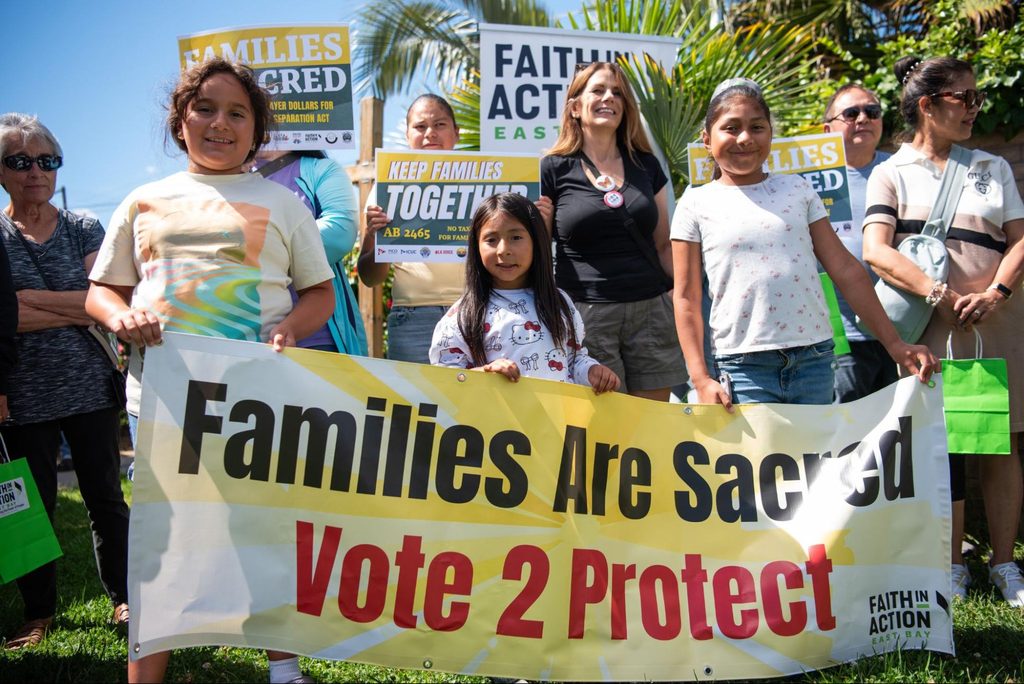
One of the messages we are using is “voting is sacred.” Human beings are sacred. Our families are sacred. Voting is one of the ways we exercise our power and influence the direction of our communities and our country. There are tremendous disparities in wealth and access in this country, but when we walk into the voting booth, each of us has a voice.
We build relationships, and then we train people to build relationships with each other. We hold house meetings and bring neighbors together. Eventually, when a group of community members sits down with a state legislator or walks into City Hall, there is a deeper message underneath whatever issue brought them there: We belong here. We have a voice. This city is ours, too, and we get to influence what happens here.
That sense of civic belonging is at the center of everything we do, and it is especially important in our civic engagement work right now. We are part of a statewide network working to turn people out to vote, including asking people in our congregations to make a commitment and a plan to vote. We are also working to meet with the county registrar of voters about how polling places will remain safe if ICE shows up and bringing clergy into the conversation about why voting matters.
One of the messages we are using is “voting is sacred.” Human beings are sacred. Our families are sacred. Voting is one of the ways we exercise our power and influence the direction of our communities and our country. There are tremendous disparities in wealth and access in this country, but when we walk into the voting booth, each of us has a voice.
Faith is an important part of how I understand that work because organizing is hard. If we are really challenging the powers that be, we are going to lose sometimes. People don’t simply give up power, and campaigns take unexpected turns. Faith values sustain us through those difficult times. They also remind us that this work is bigger than a single issue.
Activism, the way we sometimes define it, can be centered around an issue: I care about this issue, so I get involved, and when that issue is done, I step away. Organizing is about staying in it for the long haul because that is what it takes to build power.
For me, it is connected to the beloved community Dr. King talked about. I think about an Oakland and a broader East Bay where everybody truly believes their voice matters and where it actually does matter. Where families are treated as sacred, where the wealthy don’t have more influence than everybody else, where immigrants don’t have to worry about being taken off the streets, where kids can play safely in their neighborhoods, and where people have access to good education and economic opportunities.
In the Christian tradition, we talk about building the kingdom of God. In the Jewish tradition, there is the idea of repairing the world. I am a Christian pastor, and I also recognize that Christianity has at times been distorted and used as a tool of empire. But I believe at the core of my tradition is a call to recognize the sacredness and dignity of other human beings. And across faith traditions, we are called to build community with each other and recognize that we are part of something greater than ourselves.
For me, it is connected to the beloved community Dr. King talked about. I think about an Oakland and a broader East Bay where everybody truly believes their voice matters and where it actually does matter. Where families are treated as sacred, where the wealthy don’t have more influence than everybody else, where immigrants don’t have to worry about being taken off the streets, where kids can play safely in their neighborhoods, and where people have access to good education and economic opportunities.
We don’t win every time, and change does not come easily. But we don’t have to accept powerlessness as the truth about who we are. The question I keep coming back to is: Are we claiming our power? And if we’re not, why not? What is stopping us, and what would it look like for us to actually do it together?
We are not there yet. But organizing gives people a way to begin building that community together. And philanthropy has an important role to play in sustaining that work. If we want to produce the change we say we want to see, we have to invest in organizing that builds relationships, develops leaders and allows people to act together over the long term. That organizing has to be led by the people closest to what is happening, rather than people with privilege making decisions on behalf of everybody else.
We don’t win every time, and change does not come easily. But we don’t have to accept powerlessness as the truth about who we are. The question I keep coming back to is: Are we claiming our power? And if we’re not, why not? What is stopping us, and what would it look like for us to actually do it together?
