Q&A with Shana Lancaster, Special Projects Manager + Office Manager


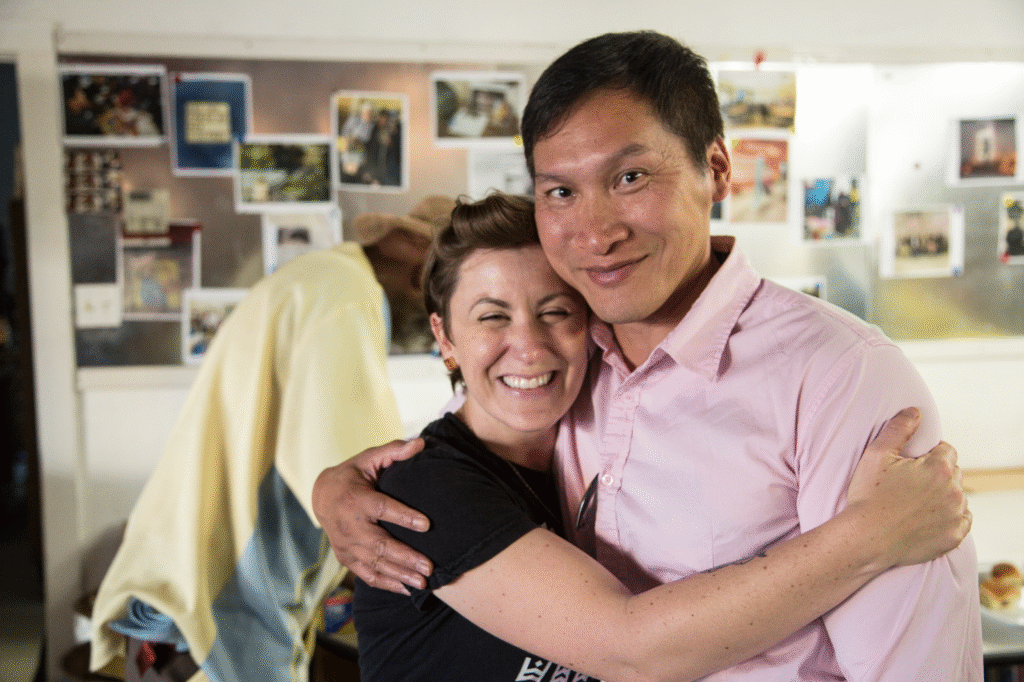
Akonadi founder and board chair Quinn Delaney, Racial Justice Poster Project artist Zoë Boston, Akonadi President Ray Colmenar, and Special Projects Manager + Office Manager, Shana Lancaster.
While Akonadi’s role as a racial justice grantmaker is a key part of our work, our role as a convener has been just as important in supporting Oakland’s movement ecosystem over the years. No one knows the power of curating an intentional gathering like Shana Lancaster, Akonadi Foundations’s Special Projects Manager + Office Manager. Shana first encountered Akonadi almost a decade ago, after attending one of the foundation’s holiday parties and immediately feeling a mix of joy, connection, and cultural vibrancy that defines our community. Today, we’re happy to have her on our team as the creative mind behind the various projects and events aimed at bringing Oakland’s organizers, artists, and movement leaders into deeper relationship with one another.
But being together, giving each other attention and care, cultivating trust, and building relationships is a cornerstone of movement building. That trust is cultivated when we’re able to be in connection.
For her anniversary reflection, we spoke with Shana about the creative practice of gathering and why cultivating spaces of joy is essential to sustaining the fight for a racially just Oakland.
Q: What are your earliest memories of working with or being connected to Akonadi?
A: My earliest memory of Akonadi goes back to 2015–16, when I was invited to one of their legendary holiday parties. At the time, I was running Mamacitas Café, a social enterprise I co-founded with Renée Geesler (former Akonadi Communications Director), focused on catering, events, and creating training opportunities for young women in Oakland. Our work aligned naturally with Akonadi’s commitment to youth power and expanding spaces of opportunity. Back then, the parties were still held in the office. I had never been to the space before, and from the outside it looked like a normal workplace. But the moment I walked through the door, it was completely transformed: the energy, the beautiful people, the food, the music. I was shy at first and unsure who I would know, but as someone born and raised in Oakland, I quickly started recognizing artists and educators I’d grown up around. And when a full Soul Train line broke out down the hallway, I was totally sold. That moment told me everything about the culture of Akonadi and who feels connected to it. Now that same office—once filled with so much joy and connection that night—is the place I walk into every day.
I first came to Akonadi as a consultant supporting RJPP events, and in 2023, I stepped into my full-time role, and it was truly the best decision I’ve ever made. After eight years of working for myself, finding a team that meets my level of care and intention felt so unique. I’m grateful I got to “date” Akonadi before fully committing, because joining the organization felt like coming home.
Q: What do you enjoy most about the art of gathering and creating events and experiences?
A: I consider myself a creative, and I see curating environments as one of my artistic practices. So many urban spaces can feel gray and understimulating, and we often underestimate how much our mood and mental state are shaped by the physical world around us. I’m really sensitive to color, sound, and scent, so creating events and gatherings becomes a way for me to gently and positively influence how people feel—using textures, objects, and design to build a temporary world that offers something different from what exists outside. People are carrying so much—stress, fear, the burdens of care—and I think having moments of sanctuary is essential. That’s what I want our events to feel like: sanctuary.

Q: Why is it important to create events and spaces for community building? How do they advance Akonadi’s vision of a racially just Oakland?
A: There is often confusion about gathering as well as arts and culture in movement work. There is this tension, as if socializing is a contradiction to political work. Yes—if people are just going out to the club and there’s no balance of engagement and intention rooted in a forward vision, of course there is valid critique. But being together, giving each other attention and care, cultivating trust, and building relationships is a cornerstone of movement building. That trust is cultivated when we’re able to be in connection. Real connection is most often possible when we’re comfortable and relaxed—part of that intentionality and creating spaces is a real technology. Joy should not be trivialized because it’s how we sustain our spirits and how we resist slipping into disillusionment or burnout.
That is one of many reasons we prioritize gatherings and doing it in a particular way. They are one of our ways of showing Oakland how we feel. We’re really clear when we think about the purpose of our programs. It’s not a time for us to just showcase what we’ve done. It’s actually a gift to our guests. We love our community so much and feel like everyone deserves so much more. We want them to eat and dance and connect and be showered with love.
All Akonadi staff and leaders of the past have paved a well-worn groove of belonging, connection, love and a fierce commitment to racial justice. It feels like a privilege to be invited to be one of the architects of how to maintain that, evolve it and move forward.
Q: Do you have a favorite Akonadi project or event you’ve worked on?
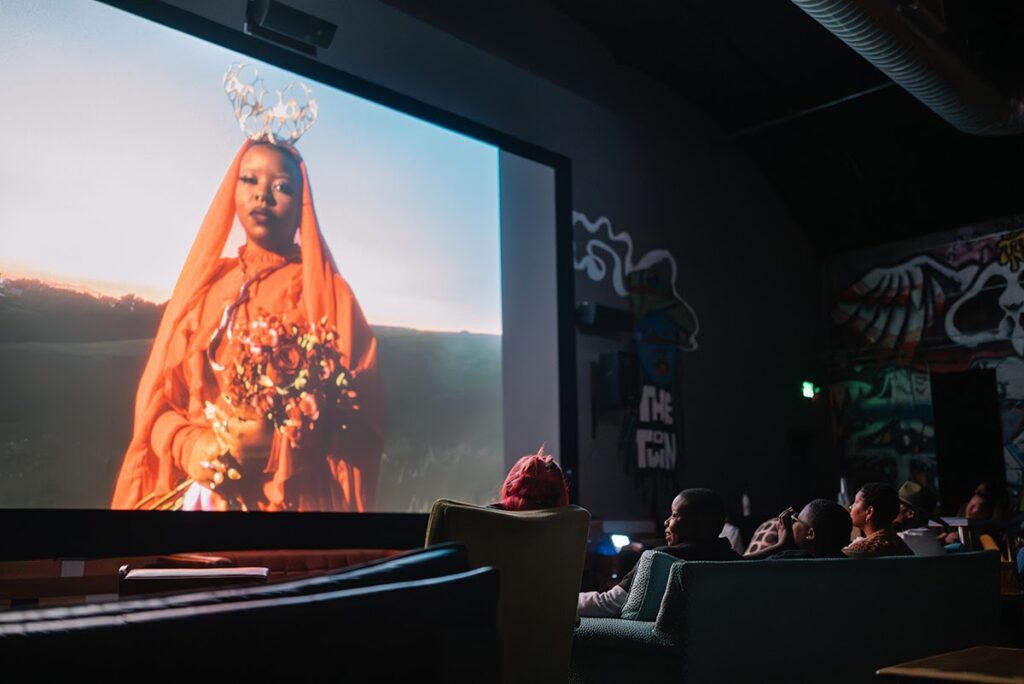
A: The Racial Justice Poster Project was really special this year because it became a fully expressed experience. We worked with Zoë Boston, an incredible multi-hyphenate—singer, muralist, and overall creative—and in addition to going through the normal commission process and poster launch, we made a short film that I produced and co-directed with Leo Maco, a filmmaker and friend. The culmination of the process was hosting a gathering to screen the film with our community, Zoë’s friends, and loved ones. I get goosebumps even talking about it. I love art and creativity so much—it’s such a brave choice to say you’re an artist in this culture and build your life around it. Artists are local superheroes! I feel so grateful that Akonadi is the kind of organization and home that invests in artists, creating archives and platforms for their work.

Q: As Akonadi marks 25 years, how does it feel to be part of that legacy of loving and caring for Oakland’s community members?
A: I love Oakland so much – it’s a very deep and wide emotion. My family has now raised four generations here. Sometimes when I’m trying to express the deepest parts of myself my words can’t capture or truly match how I feel. But, it’s been powerful to not just be a member of the community but now, one of a handful people in the driver seat trying to do justice to what has come before. All Akonadi staff and leaders of the past have paved a well-worn groove of belonging, connection, love and a fierce commitment to racial justice. It feels like a privilege to be invited to be one of the architects of how to maintain that, evolve it and move forward.
Q: When you think about the future, what is your hope for what Akonadi can accomplish in partnership with grantee partners, community members and leaders to build a more racially just Oakland?
A: Personally, I want and dream of a world where the most burdensome elements of care are held by healthy systems. People in our community are exhausted, burned out, scared and held back by the weight of handling basic needs like healthcare, housing, and education. We have to work so hard just to keep our heads above water. My dream is a world where people have their needs met and then the incredible attributes we know our community have are given space to blossom. That’s Akonadi’s vision for Oakland and I think what all of our partners are reaching for as well. I’m looking forward to continuing to be in service of that.
Outside of Akonadi, I’m plugged into various local organizing efforts and I’m blown away by the amount of people who were not organizers or politically active in the past who are now at the table. It’s been a hard and grim year, but that makes me feel excited for the future. I think we are doing a pretty good job of trying to take care of each other and there’s more people coming to the table to help. That speaks to the future of organizing and building the kind of people power to build those healthy systems for us.