
In our latest blog, we feature Founder in Residence at PolicyLink and Professor of Practice at the Goldman School of Public Policy, Angela Glover Blackwell and Founder and Board chair at Akonadi Foundation, Quinn Delaney, in a discussion about Oakland’s first-ever civic assembly, a groundbreaking, community-led process giving residents real power to shape decisions about the city and its future.
As part of the process, 40 delegates reflecting the cultural, educational, ethnicity, lived experience, and economic diversity of the Town, were selected to review data, gather community input, explore examples of successful strategies, and develop recommendations on how to transform vacant storefronts, commercial spaces, and lots into vibrant community assets.
The project is led by Angela Glover Blackwell and institutional support and project staffing is provided by PolicyLink, the Possibility Lab and Democracy Policy Initiative, both at UC Berkeley, Public Good Group, and nonpartisan nonprofit Healthy Democracy. Akonadi Foundation is proud to serve on the Community Steering Council alongside longtime partners including Black Organizing Project, East Bay Alliance for a Sustainable Economy (EBASE), Faith in Action East Bay, Brotherhood of Elders Network, Unity Council, and other Oakland organizations that are guiding this work.
Hear directly from Angela and Quinn below on the importance of this moment, why the Oakland Civic Assembly helps build a racially just society, combat apathy in a tumultuous political climate, and serve as a blueprint for building similar models across the country.
– Ray Colmenar, President, Akonadi Foundation
What makes a Civic Assembly different from simply asking residents for input?
Angela Glover Blackwell: A Civic Assembly, sometimes called a citizens’ assembly or people’s assembly, is when a randomly selected group of people comes together to have constructive dialogue around a particular issue and ultimately develop a policy proposal for a governing body.
There are a few things that are key: people are randomly selected, there is a deliberative process, they are developing specific recommendations around an issue that is important to their community, and there is a governing body expecting and receiving those recommendations.
Quinn Delaney: There is also structure around a specific question. People aren’t simply being asked for their opinions. They are given information that helps ground them in the issue and better equips them to participate.
At the same time, there is room for dialogue. People can explore an issue together, learn from each other and even evolve in their thinking. The hope is that what emerges is much more informed than what we might get from simply asking people what they think.
I started thinking that this could be interesting to try in Oakland. We have this incredibly diverse population. People don’t always agree, but they’re not necessarily poles apart. I wanted to explore what could happen if we brought diverse people together, gave them the opportunity to really work through an issue, and asked them to come up with something that they could stand behind.
Angela, where did the idea to bring a Civic Assembly to Oakland come from?
Angela: I first heard about civic assemblies at a meeting around democracy. I’m a Professor of Practice at the Goldman School of Public Policy at UC Berkeley, and one of the things happening there is the development of democracy policy. Someone mentioned citizens’ assemblies, and I hadn’t heard of them before, so I followed up and started learning more.
I found out that the practice actually originated in the United States more than 50 years ago but never really took off here. It has taken off in parts of Europe, Colombia and Brazil. The example I learned the most about was Ireland, where they formed a civic assembly to explore issues including same-sex marriage and abortion.
Knowing that those were flashpoint issues in Ireland, I was fascinated by how the process worked. The whole thing really captured my imagination.
I started thinking that this could be interesting to try in Oakland. We have this incredibly diverse population. People don’t always agree, but they’re not necessarily poles apart. I wanted to explore what could happen if we brought diverse people together, gave them the opportunity to really work through an issue, and asked them to come up with something that they could stand behind.
And I thought our elected officials might be responsive to a different kind of community input—not just the usual public meeting, but something that gives people the time, information and structure to deliberate together.
Part of what we need is a different story that we can tell the American people about the possibilities of a government of the people, by the people and for the people. And part of that means taking democracy out of the frame of just being about voting and attaching it to its North Star, which is human flourishing.
Oakland has a deep history of organizing, activism, and residents shaping the future of their communities. Why is Oakland the right place for a Civic Assembly?
Quinn: People in Oakland love to be engaged. They want to do things for their city.
The Civic Assembly builds on that by allowing people to come to the table as they are, focus on a particular issue and have real power and autonomy in the process. We provide information and guidance, but participants ultimately make the process their own. To me, that feels very much in character with who Oakland is.
Angela: Oakland is a place that is so deeply loved by so many people who have been here. People who are just passing through might wonder, what are they loving on so much here?
What we’re loving on is the way that Oakland is an activist city. When you’re out at Lake Merritt, there are people playing drums, people engaged in other cultural activities. There’s a lot of being.
Oakland has also always been diverse. The food, the culture, all of that diversity is very much embraced. That’s unusual in the United States of America. And it has been Oakland for decades.
We also have this infrastructure of community-based, power-building organizations that are close to the ground. They understand the pain, the joy and the assets that exist here. They know what needs to change for everyone to thrive and what tools must exist for those who have been left behind to shape the future they want to see.
Why is this kind of process particularly important right now?
Quinn: The Civic Assembly gives people the opportunity to look at an issue that is important in their community and come up with solutions themselves. Particularly in this moment, when so many people feel like they’re being told what to do or what to think, there is something powerful about creating a process that gives people agency over what happens in their community.
Angela: I believe our democracy is broken. We had no idea how fragile it was.
Part of what we need is a different story that we can tell the American people about the possibilities of a government of the people, by the people and for the people. And part of that means taking democracy out of the frame of just being about voting and attaching it to its North Star, which is human flourishing.
The democracy we’re working toward is a radically inclusive, mutually accountable democracy in service of human flourishing, so that society can thrive and everyone can have a good life.
Government should not just be led by those in elected office. The process of leaning in, having agency, participating and having your voice heard — that’s the of the people and by the people part.
This is a small piece of that, but it is the smaller pieces that begin to tell us who we are and eventually grow our collective power.
If we want to build power and get residents involved, we have to remove the barriers to participation and create a respectful, inviting environment in which people can debate and share ideas. We should give them good information without shoving it at them, allowing people to make their own judgments about that information. I’ll bet time after time after time, something good will come out of it.
What becomes possible when people from different backgrounds are given the time, information and resources to tackle a shared challenge?
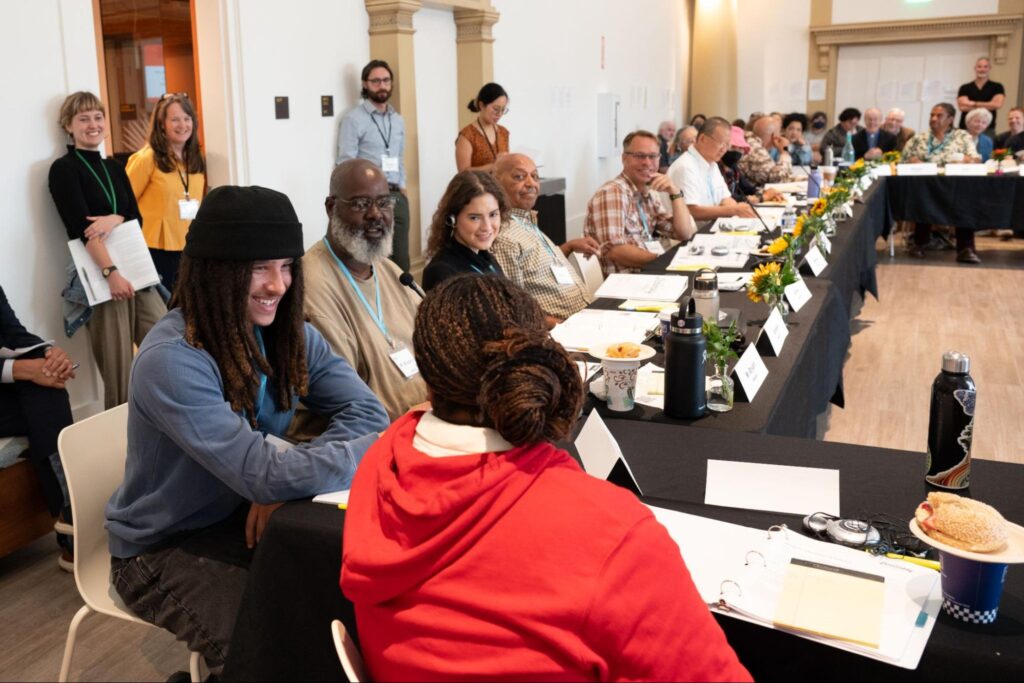
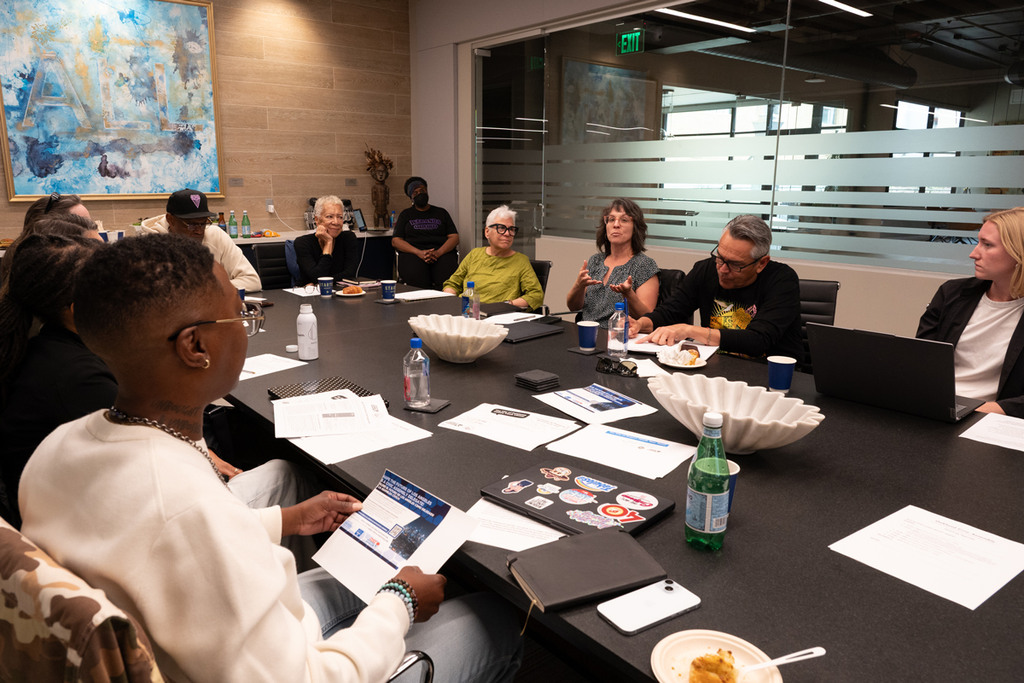
Angela: It looks like the Oakland Civic Assembly. You have all of these people represented around a single table that is square. It’s not rectangular with somebody at the head of it. There is no head of this table.
People are waiting for their turn to speak and taking their turn to speak. In small groups, people are stepping up who sometimes won’t, and people who are often the ones stepping up are stepping back so everybody gets to do it.
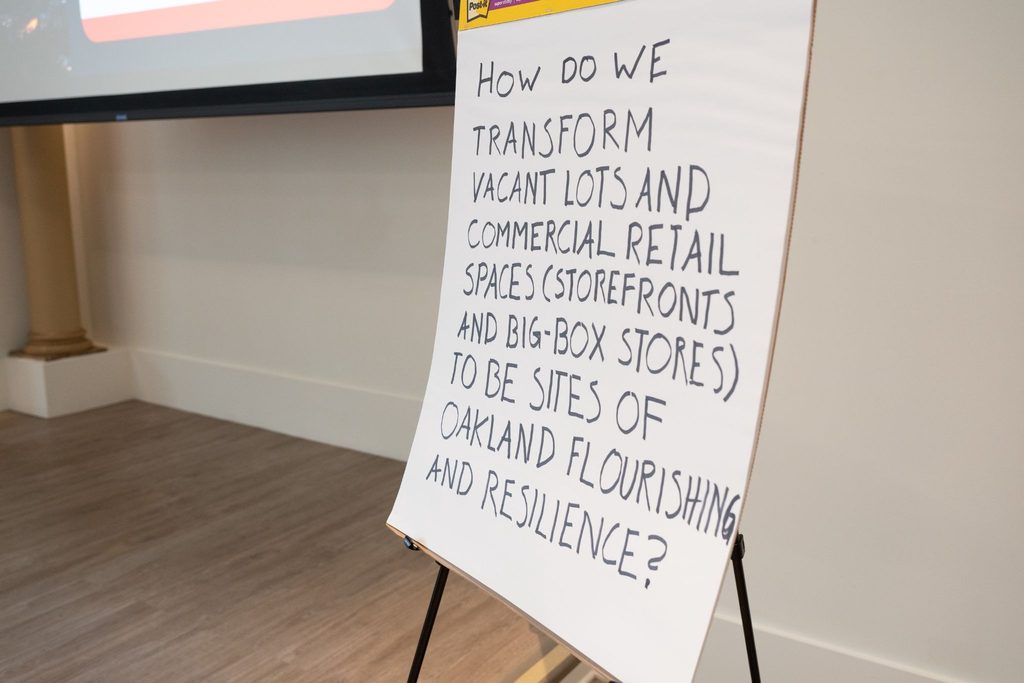
We’ve incorporated art and culture. We had someone playing the harp over lunch one day and salsa over lunch another day. We’ve had photography and puzzles. And as people are enjoying that, they’re getting to know each other. I’ve seen people putting a puzzle together and talking about the vacant lot problem, solving problems over puzzle making.
But you also have to take down the barriers to participation. People are being asked to give up full days on Saturdays and Sundays. We’re paying them. We’re paying for childcare if it’s needed, elder care if it’s needed and transportation if it’s needed.
If we want to build power and get residents involved, we have to remove the barriers to participation and create a respectful, inviting environment in which people can debate and share ideas. We should give them good information without shoving it at them, allowing people to make their own judgments about that information. I’ll bet time after time after time, something good will come out of it.
What have you seen through this process that has surprised you or challenged your assumptions?
Quinn: For me, it was the first day and seeing how interested people were and how seriously they were taking it.
People were regarding this as an important civic duty. There was a recognition that they weren’t just speaking for themselves. They understood that they were also speaking for other people in Oakland. That sense of responsibility really stood out to me.
Angela: Even the response to the invitation surprised us. We sent 20,000 invitations in three languages and received just under 400 responses, which is about twice the response rate we had been told to expect.
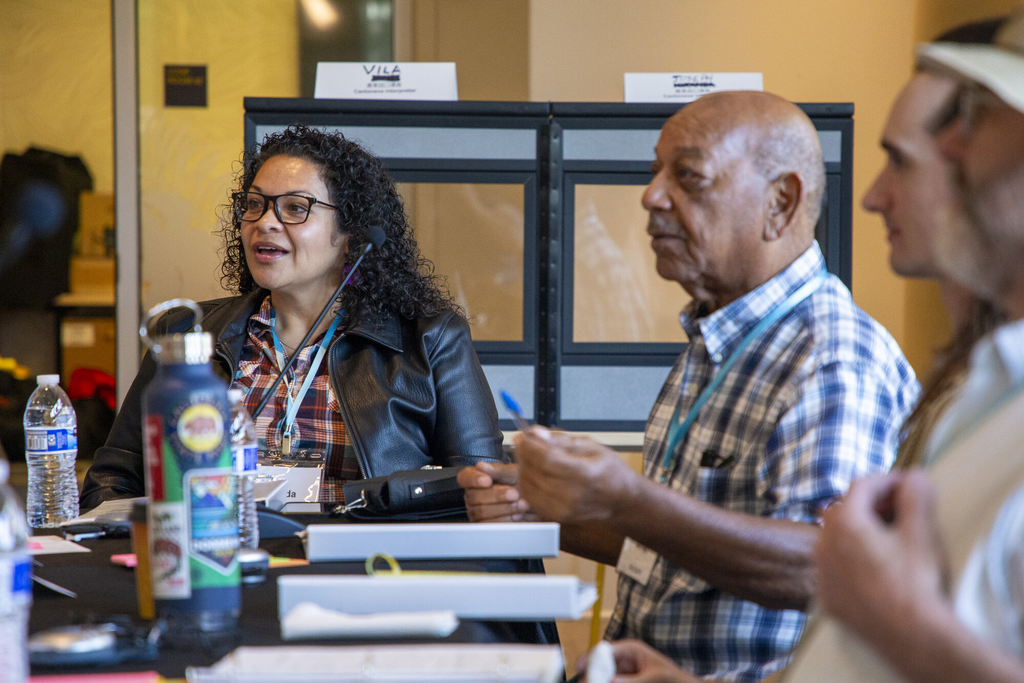
And then the people came. They showed up ready to go to work, and they are taking their job really seriously. They’re asking good questions. They’re listening hard.
We’ve now gotten to the point where people are beginning to put forward ideas after all of the information and dialogue, and I have been so impressed with the high quality of the ideas. People can take this information and translate it into policy and actions that are equal to what you would expect to come from people who are professional policymakers.
The wisdom, voice and experience of people is really impressive, and it’s coming out in this process.
If we want communities to have meaningful opportunities to exercise decision-making power, we have to be willing to put resources behind the processes that make that possible. That means investing not just in an outcome, but in the time, infrastructure and support required to bring people together, provide them with information and allow them to engage deeply with one another.
What role can philanthropy play in creating the conditions for communities to exercise greater decision-making power?
Quinn: I would love to see philanthropy embrace this as a model because a process like this does require resources. The Community Steering Council met for months to help shape this process. We’ve also had significant support from UC Berkeley and other organizations bringing different kinds of expertise to the work.
If we want communities to have meaningful opportunities to exercise decision-making power, we have to be willing to put resources behind the processes that make that possible. That means investing not just in an outcome, but in the time, infrastructure and support required to bring people together, provide them with information and allow them to engage deeply with one another.
What needs to happen for the Civic Assembly to be successful, and what do you hope comes next?
Quinn: I hope we’re able to bring the recommendations to Oakland City Council, Alameda County, and other decision-makers who can help move them forward.
Success would mean elected officials take the Assembly’s recommendations into account, really embrace the decisions participants have made and identify ways they can be implemented. I also want Civic Assembly members to leave feeling empowered and excited to be more engaged with their community.
And beyond this Assembly, success would mean both participants and policymakers see this process as having produced a uniquely positive outcome and something that can be repeated to address other community-wide issues. It can become a model.
I think once communities begin to see other communities leaning in, creating and moving forward in democratic ways that reflect care for the whole community, we’ll see innovation. We’ll find new ways to be in dialogue with one another. And we’ll begin to see that maybe we’re not as divided as we’re told we are and that when people actually get together, they often realize they have more in common than is different.
What do you hope Oakland’s experience can demonstrate for other communities across the country?
Angela: Part of what we’re hoping to do is share what we’re learning here nationally, particularly with base-building and organizing groups across the country.
I think once communities begin to see other communities leaning in, creating and moving forward in democratic ways that reflect care for the whole community, we’ll see innovation. We’ll find new ways to be in dialogue with one another. And we’ll begin to see that maybe we’re not as divided as we’re told we are and that when people actually get together, they often realize they have more in common than is different.
These are admittedly small examples. This is a little thing. But it’s little things that begin to tell us who we are. The little things in our communities help us reclaim our power.
I’ve been doing social change work for over 50 years. I’ve been an organizer, a public interest lawyer, a community builder, a foundation executive, and a policy advocate. I’ve been on lots of boards and commissions. And I have been as inspired by this experience so far as I have been by the most exciting things that I have done.
It’s different. And it’s inspiring.
